Powers of Attorney and Mumpsimi
On a number of occasions, I have decried the egregious error often made by lawyers and judges when they refer to an ‘attorney’ as a ‘power of attorney’. A power of attorney is a document that appoints a person as attorney and gives her certain powers. As I said once, ‘To call the “attorney” a “power of attorney” calls to mind the ludicrous image of a document with stick arms and legs prancing about with a silly grin on its face. Surely only the fecund and fevered imagination of a Mary Wollstonecraft Shelley, who conceived the mad scientist, Victor Frankenstein, could have engendered such a monstrosity’.[1]
Thus, if you say, ‘Jocelyn is my power of attorney’, you are calling her a piece of paper. And I doubt that she would be amused.
My fulminations seem to have had little effect, for the error continues unabated. It seems to me that we might with reason refer to a person who does not know or cannot be bothered to apply the terms, ‘power of attorney’ and ‘attorney’ correctly, as a mumpsimus. We could call him an ignoramus, but no one wants to be called that! It seems so crude. Perhaps the sobriquet, mumpsimus, would be better. Don’t you agree that it is more genteel?
And it can be applied not only to a person who misuses the terms ‘attorney’ and ‘power of attorney’, but to anyone who rigidly adheres to hidebound notions.
But what is a mumpsimus? I’m glad you asked because there is an interesting story behind this word.
One of the last prayers in the Tridentine Mass (the Latin Mass) contains the clause. ‘Quod in ore sumpsimus’. It means, ‘which (referring to the communion wafer) we have taken in the mouth’ but it can also be translated as ‘which we have taken by the mouth’.[2] The word sumpsimus is the first person plural perfect active indicative of the verb sumere, to take. Hence the translation ‘we have taken’.
It seems that there was an ignorant priest in England in the sixteenth century who thought that the last word in the quoted clause was mumpsimus. So, when he recited the Mass, he said, ‘Quod in ore mumpsimus’. When someone corrected him, he is alleged to have said, ‘I will not change my old mumpsimus for your new sumpsimus’. In consequence, thereafter, anyone who rigidly and obstinately adheres to old ways despite clear evidence of his error, or who is an ignorant and bigoted opponent of change, became known as a mumpsimus. I assure you that it is a perfectly valid English word that you can find in any good dictionary.
 You will notice that thereby a verb form, sumpsimus, was, because of an error, turned into a noun, mumpsimus. The -us ending makes it a noun of the second declension and that means that if you want to refer to more than one mumpsimus, you have to speak of mumpsimi [the final -i is pronounced -ee, not as –eye]. Of course, when we Anglicize a Latin word, we often change the plural form into an English one as well, as in ignoramuses. But that would sound odd with mumpsimus, because there would be too many uh sounds. So mumpsimi it is, as used in the title of this blog.
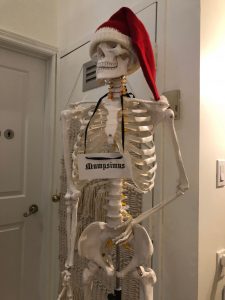
When my Pilates instructors, Katie and Kelly, opened their own studio, Grounded Pilates, they brought in a skeleton as a mascot. Then they invited their clients to name it. Because the skeleton is so rigid in its appearance, I suggested Mumpsimus. The moniker stuck, and the skeleton now graces the studio with a name tag around its neck that identifies it by that name.
—
[1] See, e.g., http://welpartners.com/blog/2019/02/power-of-attorney-and-attorney-correct-usage/, among other places.
[2] Indeed, in my copy of The Liber Usualis, the word ‘in’ is omitted, so ‘by the mouth’ is a possible translation.


Written by: Albert Oosterhoff
Posted on: January 7, 2022
Categories: Commentary
On a number of occasions, I have decried the egregious error often made by lawyers and judges when they refer to an ‘attorney’ as a ‘power of attorney’. A power of attorney is a document that appoints a person as attorney and gives her certain powers. As I said once, ‘To call the “attorney” a “power of attorney” calls to mind the ludicrous image of a document with stick arms and legs prancing about with a silly grin on its face. Surely only the fecund and fevered imagination of a Mary Wollstonecraft Shelley, who conceived the mad scientist, Victor Frankenstein, could have engendered such a monstrosity’.[1]
Thus, if you say, ‘Jocelyn is my power of attorney’, you are calling her a piece of paper. And I doubt that she would be amused.
My fulminations seem to have had little effect, for the error continues unabated. It seems to me that we might with reason refer to a person who does not know or cannot be bothered to apply the terms, ‘power of attorney’ and ‘attorney’ correctly, as a mumpsimus. We could call him an ignoramus, but no one wants to be called that! It seems so crude. Perhaps the sobriquet, mumpsimus, would be better. Don’t you agree that it is more genteel?
And it can be applied not only to a person who misuses the terms ‘attorney’ and ‘power of attorney’, but to anyone who rigidly adheres to hidebound notions.
But what is a mumpsimus? I’m glad you asked because there is an interesting story behind this word.
One of the last prayers in the Tridentine Mass (the Latin Mass) contains the clause. ‘Quod in ore sumpsimus’. It means, ‘which (referring to the communion wafer) we have taken in the mouth’ but it can also be translated as ‘which we have taken by the mouth’.[2] The word sumpsimus is the first person plural perfect active indicative of the verb sumere, to take. Hence the translation ‘we have taken’.
It seems that there was an ignorant priest in England in the sixteenth century who thought that the last word in the quoted clause was mumpsimus. So, when he recited the Mass, he said, ‘Quod in ore mumpsimus’. When someone corrected him, he is alleged to have said, ‘I will not change my old mumpsimus for your new sumpsimus’. In consequence, thereafter, anyone who rigidly and obstinately adheres to old ways despite clear evidence of his error, or who is an ignorant and bigoted opponent of change, became known as a mumpsimus. I assure you that it is a perfectly valid English word that you can find in any good dictionary.
When my Pilates instructors, Katie and Kelly, opened their own studio, Grounded Pilates, they brought in a skeleton as a mascot. Then they invited their clients to name it. Because the skeleton is so rigid in its appearance, I suggested Mumpsimus. The moniker stuck, and the skeleton now graces the studio with a name tag around its neck that identifies it by that name.
—
[1] See, e.g., http://welpartners.com/blog/2019/02/power-of-attorney-and-attorney-correct-usage/, among other places.
[2] Indeed, in my copy of The Liber Usualis, the word ‘in’ is omitted, so ‘by the mouth’ is a possible translation.
Author